In luxury markets, the product isn’t the first thing customers judge; the packaging is. The weight of a box, the feel of the paper, the precision of a closure, even the sound of a lid lifting, all contribute to how valuable, trustworthy, and well-crafted the product appears.
Packaging becomes the first proof of quality, and when it fails, scuffing, warping, or arriving damaged, it undermines the brand long before the item is revealed.
This matters even more today. Global competition has raised expectations, sustainability rules are tightening, and unboxing has become part of the brand story rather than an afterthought.
Premium brands must balance aesthetics, performance, protection, sourcing, and environmental responsibility in a single system. That’s no longer a design challenge; it’s an operational one.
This guide breaks down what modern luxury packaging really entails and how to approach it with the same rigor as product development.
You’ll find a clear look at material choices, structural engineering, unboxing design, sustainability requirements, sourcing considerations, and common strategic mistakes so you can build packaging that strengthens both brand perception and product performance.
Key Takeaways
Luxury packaging shapes perceived value, customer trust, and product quality before the product is even touched.
Material and finish choices directly influence brand perception, from rigid boxes and specialty papers to premium bags and high-end labels.
Structural engineering is a core part of the luxury experience, ensuring protection, stability, and consistency through storage, handling, and global transit.
Sustainability and sourcing now drive luxury packaging decisions, including recyclable materials, reduced laminations, color-match consistency, and lead-time reliability.
Most luxury packaging failures come from design–operations misalignment—the right systems prevent scuffing, warping, color shifts, corner damage, and finish degradation.
What is Luxury Packaging?
Luxury packaging is often described in terms of aesthetics, but the reality is much more practical.
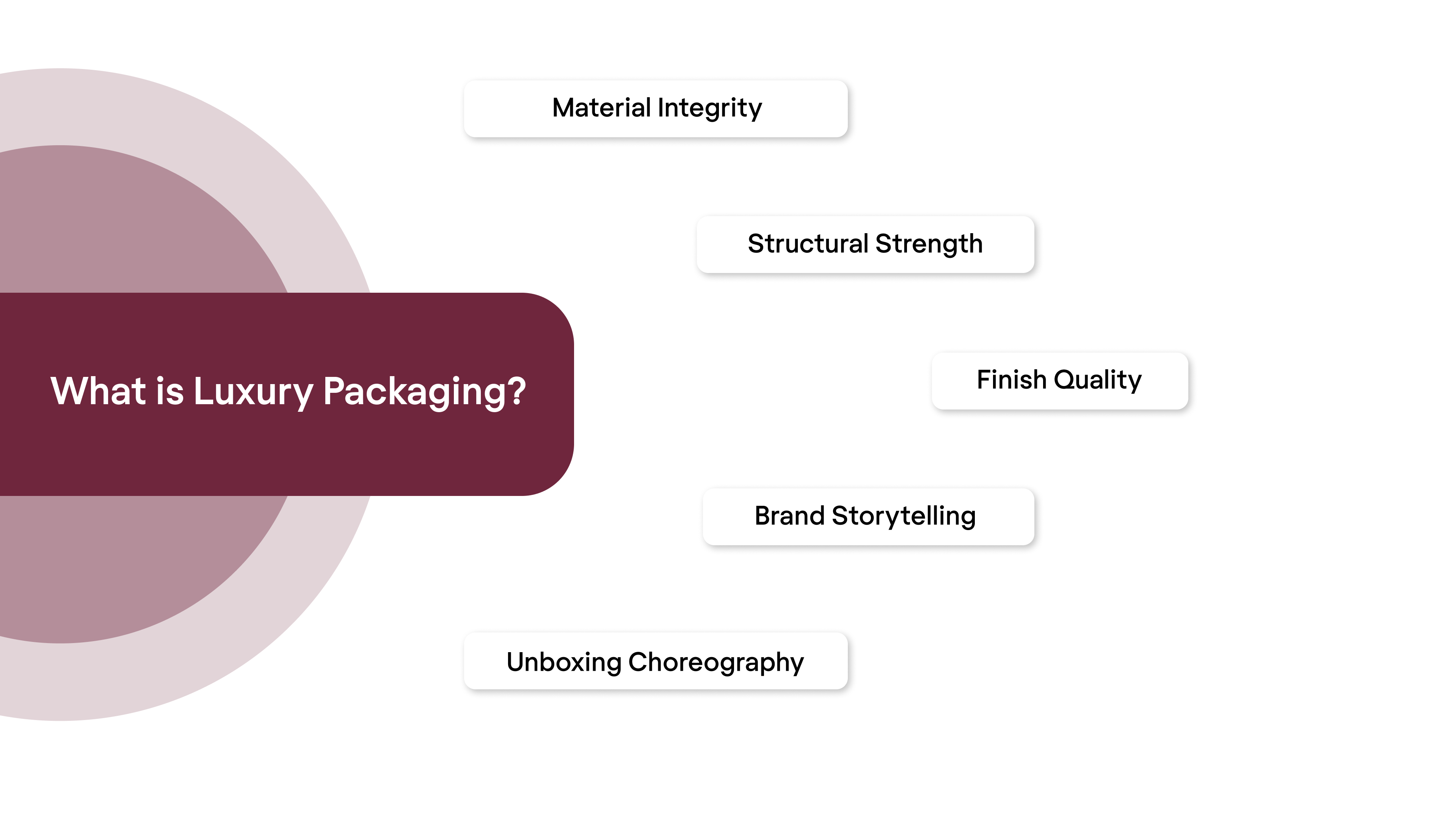
Premium brands are judged on how packaging performs, how it feels, functions, and protects, not just how it looks in a studio render. Modern luxury packaging can be understood through five measurable pillars:
1. Material Integrity
Premium boards, specialty papers, and elevated laminates are selected for behavior, not just beauty. Stronger materials maintain color, rigidity, and surface quality after repeated touches, shelf time, or long-distance freight.
Micro-psychology: Heavier materials immediately signal value. Thicker walls create a sense of durability before the product is revealed.
2. Structural Strength
High-end packaging must hold shape under pressure: no corner collapse, no warped lids, no internal movement. The structure protects both the product and the perception of craftsmanship.
Micro-psychology: A precise, friction-controlled lid lift or magnetic closure reinforces the perception of craftsmanship and reduces “cheapness cues.”
3. Finish Quality
Soft-touch coatings, textured papers, foils, varnishes, and metallic accents must remain clean, consistent, and scuff-resistant. Luxury finishes lose their value if they are marred during manufacturing, packing, or delivery.
Micro-psychology: Texture is memory-forming; the feel of a box surface gives customers a subconscious cue of refinement and authenticity.
4. Brand Storytelling
Typography, color precision, tactile cues, and layout work together to express identity. Luxury uses calibrated, intentional design choices to communicate sophistication.
Micro-psychology: The “moment of reveal” shapes emotional response, how the lid opens, how the product sits, how the inner materials guide attention.
5. Unboxing Choreography
Premium packaging creates a controlled, intentional sequence: the first glance, first touch, first movement, and final reveal. Each step should feel deliberate and consistent with the product’s value.
Micro-psychology: Sound matters more than most brands realize. The soft lift of a rigid lid, the click of a magnetic closure, or the smooth pull of a drawer box can reinforce a premium impression instantly.
Luxury packaging today is defined by how well these pillars work together. When materials, structure, finishes, storytelling, and the unboxing flow align, the packaging elevates both the product and the brand.
When they don’t, even a well-designed box can feel ordinary.
Material & Finish Systems for Luxury Brands
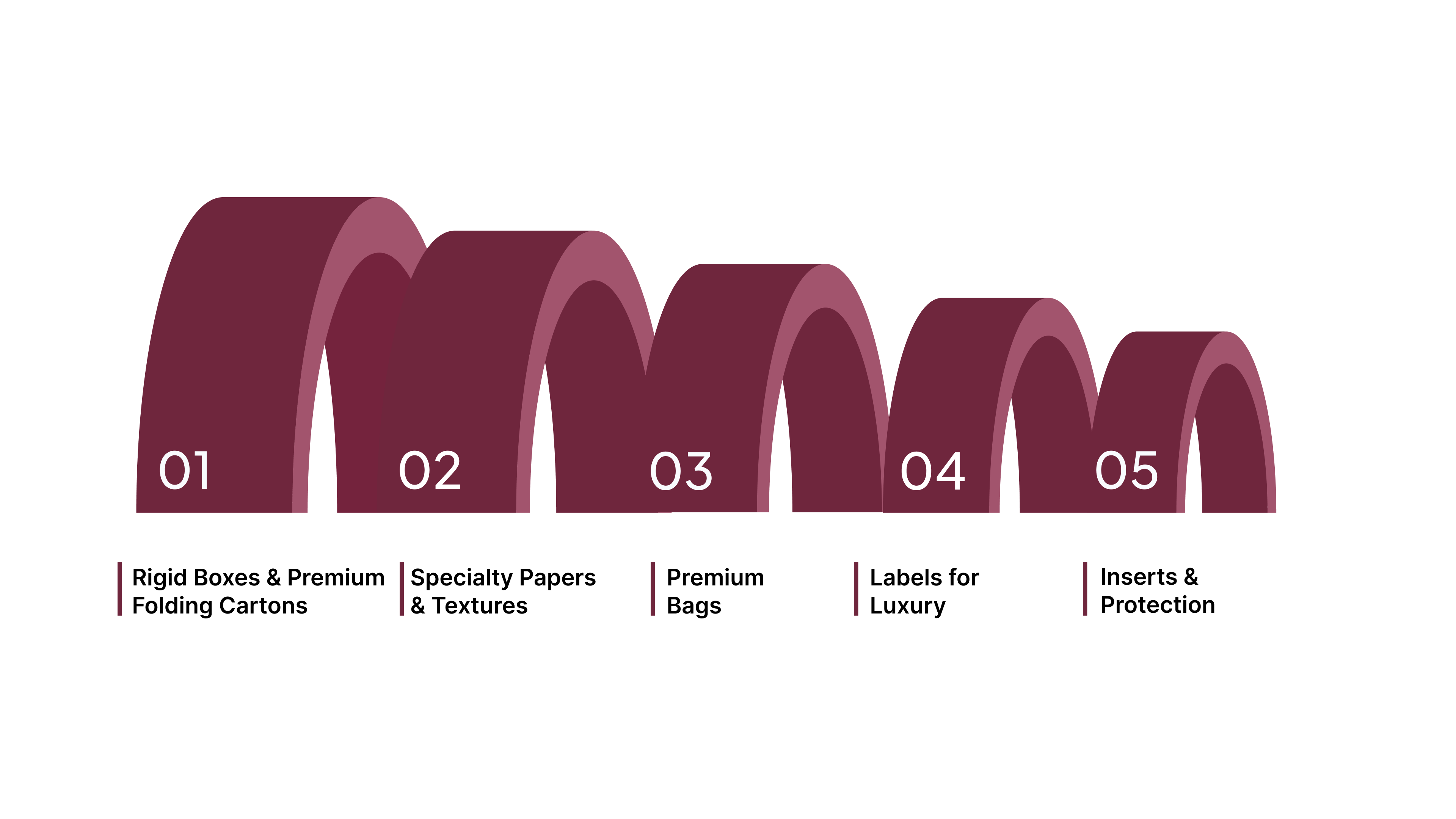
Luxury packaging starts with choosing materials that match the brand’s position, the product’s demands, and the unboxing experience you want to create.
Below is a practical breakdown of the materials used most often in premium categories and how to select the right option for your product.
Rigid Boxes & Premium Folding Cartons
Rigid boxes (set-up boxes) are the benchmark for luxury unboxing. Folding cartons offer a lighter, more cost-efficient option while still supporting premium finishes.
Best for:
High-value accessories, cosmetics, electronics, fragrance, fine jewelry, specialty retail.
Selection logic:
Brand Positioning: Rigid boxes convey permanence; folding cartons signal elegance with efficiency.
Product Weight: Heavier or fragile items perform best with rigid board walls.
Unboxing Sequence: Rigid boxes allow slower, more theatrical reveals; cartons suit fast-open retail experiences.
Sustainability: FSC-certified boards + removable inserts maintain recyclability.
Specialty Papers & Textures
The outer wrap defines the first tactile impression. Luxury brands rely on specialty papers such as:
Soft-touch
Linen and woven textures
Coated and uncoated premium stocks
Metallic or pearlescent finishes
Natural kraft (premium unbleached aesthetic)
Selection logic:
Brand Positioning: Soft-touch = modern minimal; textured = heritage; metallic = high-gloss luxury.
Product Weight: Heavy textures pair well with rigid boards; lightweight papers suit folding cartons.
Unboxing Sequence: Use tactile contrast (matte + foil) to guide attention.
Sustainability: Choose papers with recycled content or without film lamination where possible.
Premium Bags (Paper, Fabric, Laminated)
Luxury retail uses bags not as carriers but as brand artifacts. They must hold shape, maintain print richness, and feel substantial.
Types used most:
Heavyweight paper bags
Laminated gloss/matte bags
Fabric bags (cotton, canvas, satin)
Non-woven premium totes
Selection logic:
Brand Positioning: Fabric bags signal exclusivity; heavyweight paper suits modern brands; lamination supports visual intensity.
Product Weight: Choose reinforced bases and handles for accessories, footwear, and bottles.
Unboxing Sequence: Bags define the “entry moment” to the full experience.
Sustainability: Fabric bags support reuse; unlaminated paper supports recyclability.
Labels for Luxury (PSLs, Tactile Finishes, Foil Accents)
Labels act as micro-packaging, reinforcing luxury cues even on simple containers.
Common luxury label elements:
Pressure-sensitive labels with premium adhesives
Foil stamping (gold, rose gold, holo)
Embossing/debossing
Textured facestocks
Spot varnishes or tactile coatings
Ultra-clear “no-label-look” films
Selection logic:
Brand Positioning: Metallic + embossing = luxury heritage; clear labels = modern minimalism.
Product Weight/Fragility: For glass, metal, or curved surfaces, use conformable facestocks.
Unboxing Sequence: Label texture influences grip and first touch.
Sustainability: Look for recyclable facestocks, wash-off adhesives, and unlaminated papers.
Inserts & Protection (Chipboard + Corrugated)
Luxury packaging fails if the product shifts or rattles. Inserts are essential for a premium perceived value.
Formats include:
Chipboard inserts
Paper pulp trays
Corrugated supports
Foam alternatives (paper-based where possible)
Selection logic:
Brand Positioning: Paper-based inserts feel elevated and sustainable; molded pulp offers a modern, organic aesthetic.
Product Weight/Fragility: Heavy or delicate items require multi-layer or reinforced inserts.
Unboxing Sequence: Inserts create staging, raising, centering, or nesting products.
Sustainability: Replace foam with recyclable chipboard or molded pulp where possible.
In luxury packaging, material choice is never aesthetic alone; it’s a structural, tactile, and brand-alignment decision.
Getting the combination right is what creates a premium experience without compromising practicality.
Structural Engineering: Protection Is Part of the Luxury Experience
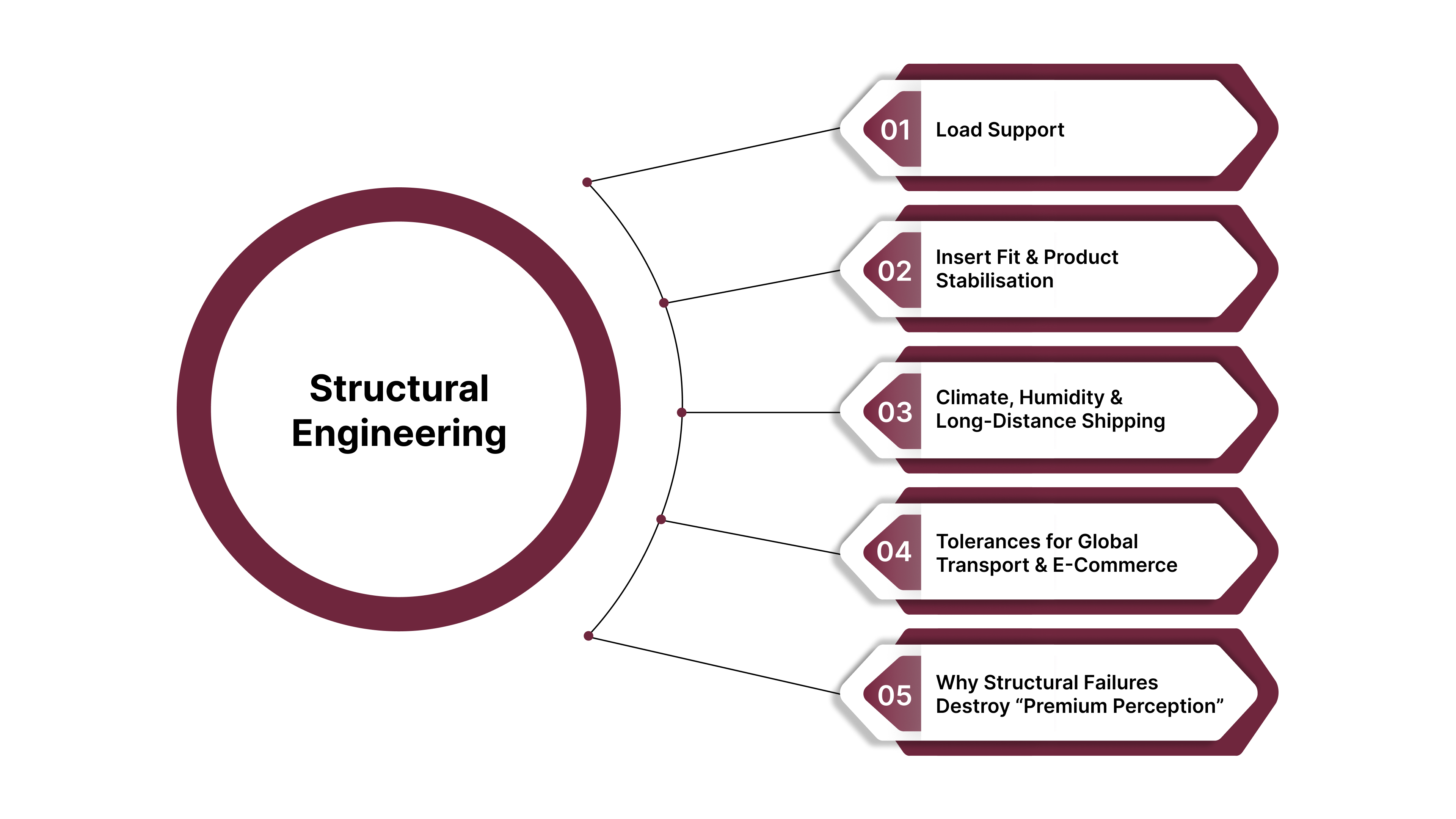
Before a customer sees the product, they feel the structure. The firmness of the walls, the stability of the lid, the stillness of the item inside, these cues quietly confirm whether the brand delivers true luxury or just surface-level polish.
Below are the structural elements that truly influence premium performance.
Load Support
Luxury packaging must hold its shape throughout:
Warehouse stacking
Distribution pressure
Retail storage
E-commerce handling
The product’s own weight
Reinforced walls, stable panel design, and appropriate board selection prevent corner crush, bowing, and compression, problems that quickly undermine a high-end impression.
Insert Fit & Product Stabilisation
The product should appear positioned intentionally, not loosely placed.
Well-engineered inserts:
Keep the product centered
Prevent rattling or micro-movement
Protect delicate edges or finishes
Guide the unboxing flow
Maintain visual alignment when the lid opens
Chipboard inserts, wrapped boards, molded pulp, or layered card systems all help deliver a precise reveal.
Climate, Humidity & Long-Distance Shipping
Luxury packaging often crosses climates and handling environments that challenge paper-based materials. Structural choices must account for:
Humidity that softens the board or distorts wrapped surfaces
Temperature swings that weaken adhesives or cause lamination shifts
UV exposure that affects color consistency
Long transit durations where compression accumulates
If the structure isn’t engineered for these variables, even the best surface finishes can warp or bubble.
Tolerances for Global Transport & E-Commerce
As more luxury brands ship direct-to-consumer, packaging must perform beyond controlled retail environments.
Critical tolerances include:
Drop resistance
Vibration endurance
Edge and corner protection
Fit within secondary mailers
Stability through automated sortation systems
Seal integrity after multiple carrier handovers
A rigid box that looks flawless on a shelf must also survive a 10-day multi-carrier journey without losing its shape.
Why Structural Failures Destroy “Premium Perception”
Customers evaluate luxury within seconds. Any structural defect, even a minor one, carries an outsized emotional impact.
Examples:
A crushed corner signals fragility
A loose insert feels careless
A warped lid gives a “cheap” tactile cue
A scuffed or distorted surface breaks the illusion of refinement
Luxury is about control. Structural integrity is the customer’s first proof that the brand has it.
Luxury Packaging Failure Modes
Luxury packaging fails in very specific and obvious ways. These issues aren’t cosmetic; they immediately undermine perceived value. Understanding the common failure modes helps brands prevent quality slips that customers notice instantly.
1. Corner Compression
Rigid boxes that lack adequate structural support can deform under stacking pressure or impact, creating visible dents that immediately signal poor engineering.
2. Surface Marring on Premium Coatings
Soft-touch and tactile papers can develop glossy rub marks or abrasions when they’re not paired with the right protective varnishes or when friction in transport is underestimated.
3. Foil or Embellishment Fracture
Foil stamps, metallic accents, and embossed elements can crack or flake when applied to materials that flex, expand, or shift with temperature and humidity changes.
4. Closure Misalignment
Magnetic and friction-fit closures require tight tolerances. Minor inconsistencies in board thickness or wrap tension can cause lids that don’t align cleanly or closures that fail to “seat” with precision.
5. Climate-Induced Panel Shift
High humidity or temperature swings alter fiber tension in wrapped rigid boxes, leading to lids that sit unevenly or panels that lose their flatness — a subtle but highly visible premium failure.
6. Batch-to-Batch Color Variation
Natural papers, laminates, and inks can absorb color differently across production runs. Even small tone differences break the seamless visual consistency that luxury brands rely on.
7. Adhesive Failure on Textured or Coated Surfaces
Labels, internal seals, or decorative elements can lift when the substrate texture, varnish, or coating reduces surface bonding. This becomes especially noticeable on linen, uncoated, or highly tactile papers.
8. Insert Misalignment
Inserts that aren’t engineered to precise tolerances can shift during transit, causing the product to sit off-center or reveal unexpected gaps — disrupting the carefully designed reveal moment.
9. Edge Fraying on Specialty Papers (Optional Extra if Needed)
Certain uncoated or fiber-rich papers can show fraying or feathering along edges if cutting, wrapping, or scoring isn’t optimized for their grain structure.
Luxury packaging must satisfy design, durability, and supply continuity, all at once.
GMS Industries brings materials expertise, multi-location production, and controlled manufacturing to help brands create packaging that looks exceptional and performs consistently.
Connect with the team to explore the right solutions for your line.
Sustainability Requirements for Modern Luxury Brands
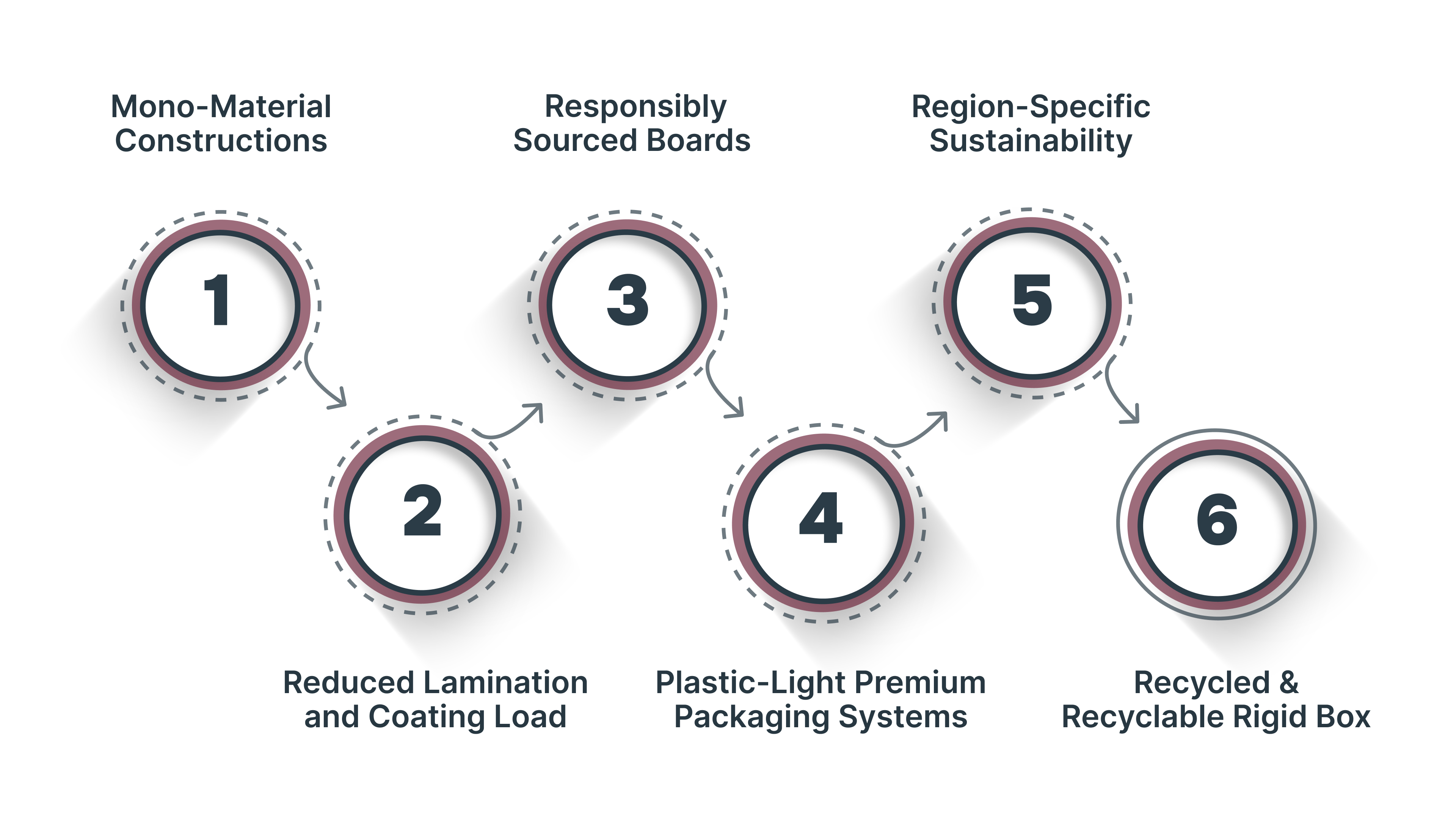
Sustainability is no longer an optional “nice to have” in luxury packaging. Global brands are now expected to deliver premium experiences without excessive coatings, plastics, or complex material mixes that complicate recycling.
The challenge is achieving a high-end feel while keeping packaging compliant, efficient, and responsibly sourced.
Below are the sustainability standards shaping luxury packaging today, the ones auditors, retailers, and regulators actually check.
Mono-Material Constructions
Luxury packaging is shifting toward single-material systems that simplify recycling.
Mono-material boards reduce:
Separation requirements
Sorting complexity
Contamination risks in recycling streams
Regional compliance issues
Rigid boxes, folding cartons, and inserts built from the same paper family now represent the new “premium minimalism.”
Reduced Lamination and Coating Load
Heavy laminations once signaled luxury; today, they raise red flags for recyclability and carbon impact.
Modern luxury brands use:
Minimal or water-based coatings
Soft-touch alternatives that avoid plastic films
Varnishes that provide tactile depth without blocking fiber recovery
The goal isn’t to eliminate finishes, it’s to balance sensory experience with responsible material choices.
FSC-Certified or Responsibly Sourced Boards
FSC-certified board has become a baseline requirement for luxury brands selling globally.
It ensures:
Verified, responsibly managed forest sourcing
Traceability across the supply chain
Compliance with major retailer and regulatory expectations
High-end consumers increasingly look for these certifications during unboxing or on outer cartons.
Plastic-Light Premium Packaging Systems
Luxury doesn’t depend on plastic components anymore. Brands are replacing:
PET lamination → paper-based soft-touch coatings
Foam inserts → molded pulp, chipboard, or wrapped board systems
PVC windows → die-cuts or recyclable alternatives
Plastic closures → magnetic, friction-fit, or paper-engineered solutions
These changes maintain a premium feel while reducing waste volume and disposal issues.
Region-Specific Sustainability & Compliance
Sustainability expectations differ across major markets. Structural and material decisions must align with:
EU Requirements
Packaging and Packaging Waste Regulation (PPWR)
Recyclability documentation
Limits on plastic components and laminates
US Requirements
State-level EPR programs
Recycled content mandates
Labeling and disposal claims (e.g., “recyclable,” “compostable”)
Canada & APAC
Printed material regulations
Packaging recovery targets
Plastics phase-out programs
Ignoring these differences can block shipments or create rework across SKUs.
Recycled & Recyclable Rigid Box Systems
Recycled fiber content is becoming a non-negotiable for many high-end retailers.
Luxury-ready recycled systems now include:
High-density rigid boards with stable recycled content
Specialty papers made from post-consumer fibers
Recyclable rigid constructions without hidden foils or plastic layers
Premium tactile papers that retain feel without compromising recyclability
These choices help brands meet sustainability goals without diluting the premium impression.
By aligning materials, finishes, and structure with these sustainability standards, luxury brands can create packaging that performs beautifully, ships reliably, and stands up to evolving environmental requirements.
Operational & Procurement Realities
The most successful brands treat packaging as part of operations, procurement, and logistics, not just aesthetics. Below are the factors that matter most to teams responsible for cost control, continuity, and performance.
Lead Times & MOQ Realities
Premium materials, rigid boards, specialty papers, foils, and custom inserts require longer production windows than standard packaging.
Procurement teams must plan for:
Longer artwork lock-in periods
Forecast-dependent material reservation
Higher MOQs for specialty boards, papers, and finishes
Seasonal congestion, especially for global shipping
Planning these cycles early prevents last-minute substitutions that degrade quality.
Batch & Color Consistency
Luxury relies heavily on color precision and surface uniformity. Even minor shifts in the following production factors can compromise quality:
Paper absorption
Lamination batches
Foil rolls
Ink mixing
Wrapping tension
Any inconsistency can lead to noticeable differences on the shelf or in unboxing.
Consistent quality requires controlled sourcing, calibrated equipment, and repeatable finishing processes.
Global Supply Stability
When packaging is produced across multiple regions, consistency becomes harder to maintain. Operationally, brands need:
Reliable multi-location manufacturing
Identical material specifications across regions
Redundancy for critical components
Predictable freight timelines
Without supply stability, brands face delays that disrupt launches, PR events, and retailer distribution cycles.
SKU Complexity & Forecasting
Luxury brands often manage dozens or hundreds of packaging variations across:
Seasonal drops
Shade extensions
Limited editions
Multi-component gift sets
Operational efficiency depends on tightly coordinated forecasting, version control, and preventing SKU bloat that creates cost and inventory friction.
Protective Performance vs. Cost
Premium packaging must balance:
Structural strength
Material density
Insert engineering
Dimensional weight costs
Shipping and warehousing efficiency
The goal is protection without over-engineering. Luxury packaging must feel substantial but still move efficiently through global logistics systems.
Impact on Shipping, Storage & Returns
Packaging directly influences operations:
Too much void → product movement → returns
Too fragile → corner crush → reboxing costs
Too heavy → increased freight and DIM charges
Too slow to pack → bottlenecks at fulfillment
Too complex → inconsistent assembly across regions
Optimized design reduces operational friction and protects margins.
When luxury packaging is engineered with real operational constraints in mind, it stops being a cost line and becomes an enabler supporting smoother launches, tighter supply-chain control, and a brand experience that holds its standard everywhere it ships.
Common Strategic Mistakes Luxury Brands Make
Even well-positioned luxury brands run into preventable packaging issues when design, operations, and sourcing aren’t aligned. These are the most frequent pitfalls that weaken brand perception and inflate cost.
Over-Designing Beyond Manufacturability
Complex structures, untested closures, and ultra-thick wraps look great in concept but often fail in production or require cost-prohibitive manual labor.
Choosing Finishes That Don’t Survive Shipping
Soft-touch, foils, and high-gloss laminates can scuff, crack, or warp if the finish isn’t paired with appropriate substrates and handling conditions.
Splitting Production Across Suppliers Without Color Controls
Different converters produce slight shifts in shade, foil tone, and texture, leading to visible inconsistency across SKUs and regions.
Treating Sustainability as an Add-On Instead of a Constraint
Brands often finalize designs before verifying recyclability, mono-material limitations, or regional compliance, resulting in costly redesigns.
Locking Packaging Before Product Specs Are Final
Changes in weight, size, or accessories can make inserts unusable or cause structural failures, forcing retooling or waste.
Seeing Packaging as a Design Element Instead of a System
Luxury packaging must align design, protection, logistics, and supply continuity; treating it as a purely aesthetic task leads to failures downstream.
Even with strong design intent, these mistakes tend to surface when packaging moves from concept to production.
The difference between packaging that simply looks premium and packaging that performs like it came from a luxury brand often comes down to the partner behind it.
That’s where a supplier with disciplined engineering, material control, and multi-category capability makes the real impact.
How GMS Industries Helps Luxury Brands
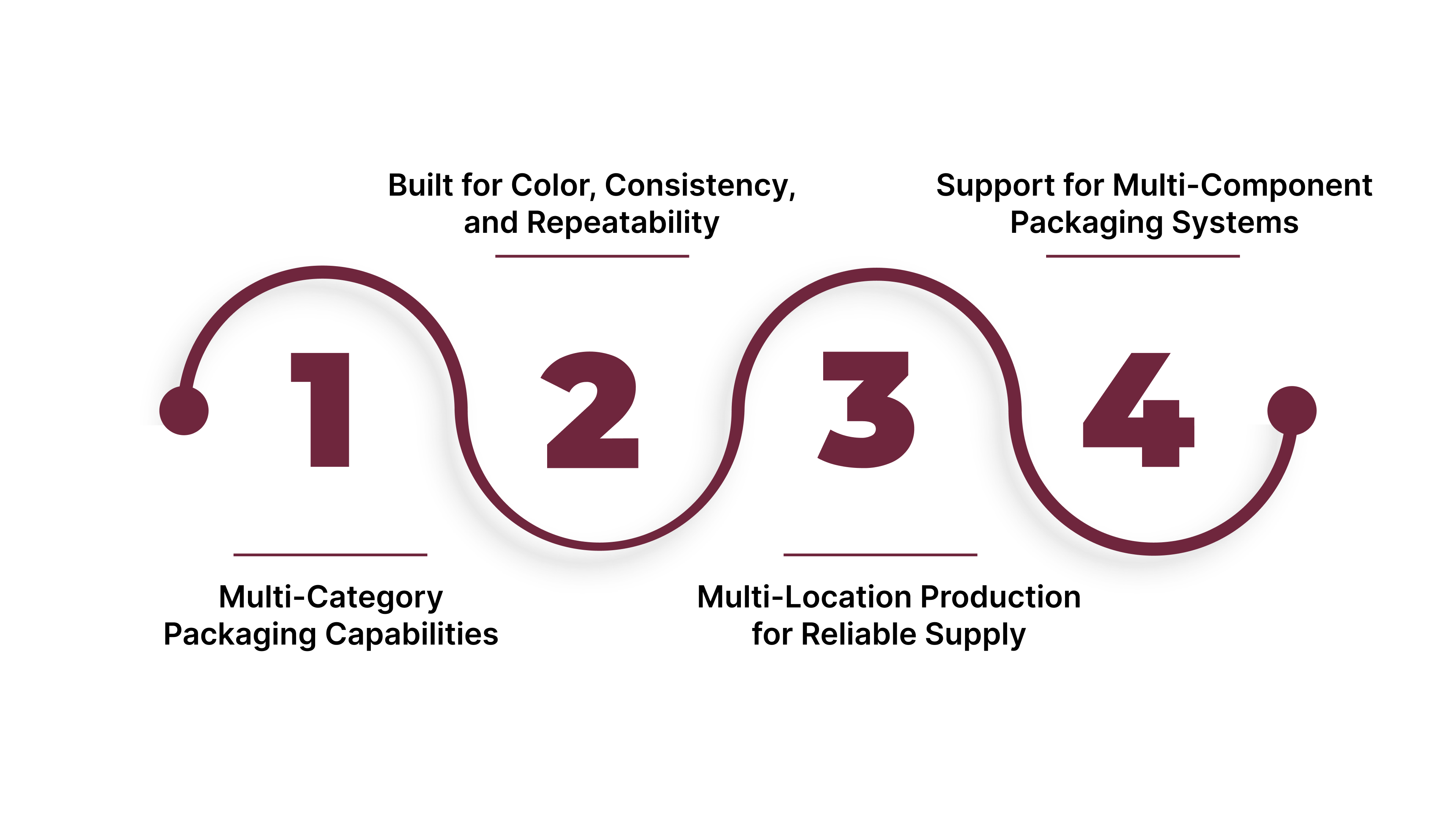
Luxury packaging only works when every component, boxes, bags, labels, inserts, and outers, performs consistently across batches, seasons, and supply locations.
GMS Industries supports operational reliability with a manufacturing footprint and material expertise built for premium categories.
Multi-Category Packaging Capabilities
GMS provides the components luxury brands rely on most, with the production consistency required for high-standard markets:
Premium printed bags for retail and gifting
High-quality pressure-sensitive labels for cosmetics, skincare, fragrance, and premium CPG
Chipboard inserts and supports are engineered to stabilize and stage products
Corrugated outers and protective packaging for e-commerce and global distribution
Rigid boxes available on request, enabling complete luxury kits or gift sets
This range allows brands to streamline vendors while ensuring all elements of the packaging system work together.
Built for Color, Consistency, and Repeatability
Luxury brands cannot afford tonal drift or finish variation.
GMS supports this through:
Tight color-match and batch consistency controls
Standardized material combinations for repeatability
Controlled printing and finishing processes across facilities
This reduces the risk of mismatched components across SKUs or replenishment cycles.
Multi-Location Production for Reliable Supply
With manufacturing in both the U.S. and Mexico, GMS helps brands:
Reduce transit risk and lead-time volatility
Build regional redundancy and supply continuity
Support faster replenishment during seasonal peaks
This footprint is particularly valuable for brands with multi-market fulfillment or rapid product cycles.
Support for Multi-Component Packaging Systems
Luxury packaging rarely involves a single item.
GMS works with teams to ensure:
Labels fit the materials and finishes used on rigid or folding cartons
Inserts lock products into place without compromising the reveal
Outer corrugated safety protects the full kit during shipping
All components maintain visual alignment across the unboxing sequence
This systems-level view is what ensures the final experience feels cohesive—not pieced together.
If you’re refining luxury packaging, evaluating new materials, or building multi-component systems, GMS Industries can help you select and produce components that uphold both brand standards and operational demands. Request a quote.
Conclusion
Luxury packaging works best when it integrates brand storytelling with material integrity, structural stability, and operational predictability. When any of these elements fall short, even slightly, the unboxing experience weakens and the product’s perceived value drops.
Here are a few practical next steps for teams refining their packaging systems:
Audit current packaging across conditions, not just appearance.
Test under real transit, climate, and handling scenarios to identify weak points in structure, finish, or color consistency.
Map your packaging system as a whole.
Look at how labels, inserts, bags, cartons, and outers work together rather than optimizing each component in isolation.
Align sustainability goals with material choices early.
Ensure mono-material options, reduced lamination, and FSC-certified boards are part of the design requirements, not retrofitted later.
Address procurement variables upfront.
Confirm lead times, MOQ flexibility, batch consistency, and regional availability before finalizing any packaging spec.
If you’re considering upgrades or troubleshooting current systems, GMS Industries can help evaluate the materials, formats, and constructions that support both premium aesthetics and dependable performance.
FAQ
1. What actually makes packaging “luxury”?
Luxury packaging combines high-integrity materials, precise structural engineering, refined finishes, and an intentional unboxing sequence that elevates product perception.
2. Why does structural strength matter for premium packaging?
If a box warps, dents, or collapses, it immediately breaks the illusion of quality, regardless of how beautiful the surface design is. Structure is part of the luxury experience.
3. Are sustainable materials compatible with luxury finishes?
Yes. Modern premium systems use FSC boards, reduced lamination, recyclable wraps, and tactile papers that maintain a luxury feel without compromising sustainability requirements.
4. How do brands ensure color consistency across batches?
By standardizing substrates, controlling ink sets, using calibrated equipment, and working with suppliers who run disciplined batch-color checks across locations.
5. What causes luxury packaging to fail during shipping?
Common issues include humidity-driven warping, insufficient load support, loose inserts, fragile coatings, and incompatible outer packaging.
6. Can one packaging supplier handle multiple luxury components?
Yes, partners like GMS can supply labels, inserts, corrugated outers, and premium bags, allowing brands to streamline sourcing and maintain consistent visual and structural quality.