If you’ve sourced cardboard boxes recently, you’ve probably noticed the prices don’t sit still. The same box can cost $1.20 from one supplier and $1.80 from another, and with packaging making up 10–15% of product cost in many industries, that difference adds up fast.
Raw material prices fluctuate, freight keeps rising, and quotes vary so widely that budgeting becomes frustrating for operations and procurement teams alike. Before you can control costs, you need a clear understanding of what a box should cost and why those prices change.
This guide gives you exactly that: realistic 2025 cost ranges, the factors that influence price, and practical ways to avoid overpaying.
Key Takeaways
Most cardboard boxes cost $0.35–$5.00+, depending on type, size, materials, and printing.
Typical ranges:
Folding cartons: $0.25–$1.00
Corrugated shippers/mailers: $0.75–$3.50
Rigid boxes: $4.00–$10.00+
The biggest cost drivers are material grade, box dimensions, printing method, order quantity, and freight.
Small orders cost significantly more due to setup and tooling.
Most brands overpay by choosing stronger materials than necessary or ordering in inefficient volumes.
Working with a nearby supplier reduces freight, often one of the most overlooked cost factors.
What Type of Box Are You Manufacturing? (Costs Vary Widely)
Before you can estimate cost, you need to know which box you’re producing. Different structures use different materials, printing methods, and manufacturing processes, and the price difference can be dramatic.
1. Folding Cartons (Paperboard Retail Boxes)
Used for cosmetics, supplements, small electronics, and retail-ready packaging.
Typical Cost: $0.25–$1.00 per box
Why they’re affordable:
Made from lightweight paperboard
Fast to print and convert
Ideal for high-volume retail packaging
Cost rises when:
You add premium finishes (foil, embossing, matte coatings)
You use thicker SBS or specialty materials
Structural designs become more complex
2. Corrugated Boxes (Shipping Boxes & Mailers)
The most common packaging for e-commerce and logistics.
Typical Cost: $0.75–$3.50 per box
Why they cost more than folding cartons:
Corrugated flutes (B, C, E, double-wall) use more material
Stronger board = higher protection + higher cost
Larger dimensions increase material usage quickly
Most common formats:
Regular slotted cartons (RSC)
Locking mailer boxes
Die-cut custom shippers
Shipping boxes often represent the bulk of a brand’s packaging budget.
3. Rigid Setup Boxes (Premium Packaging)
Used for luxury goods, electronics, and gift sets.
Typical Cost: $4.00–$10.00+ per box
Why they’re expensive:
Made from dense chipboard wrapped in printed paper
Labor-intensive construction
Often include magnets, foam inserts, or laminations
These boxes elevate the unboxing experience, but are rarely economical for everyday fulfillment.
Quick Cost Comparison
Box Type | Typical Cost Range | Best For |
|---|---|---|
Folding Cartons | $0.25–$1.00 | Retail packaging, lightweight products |
Corrugated Boxes | $0.75–$3.50 | Shipping, e-commerce, protective packaging |
Rigid Boxes | $4.00–$10.00+ | Premium brands, gift sets, luxury items |
What Actually Drives the Cost of Manufacturing a Cardboard Box?
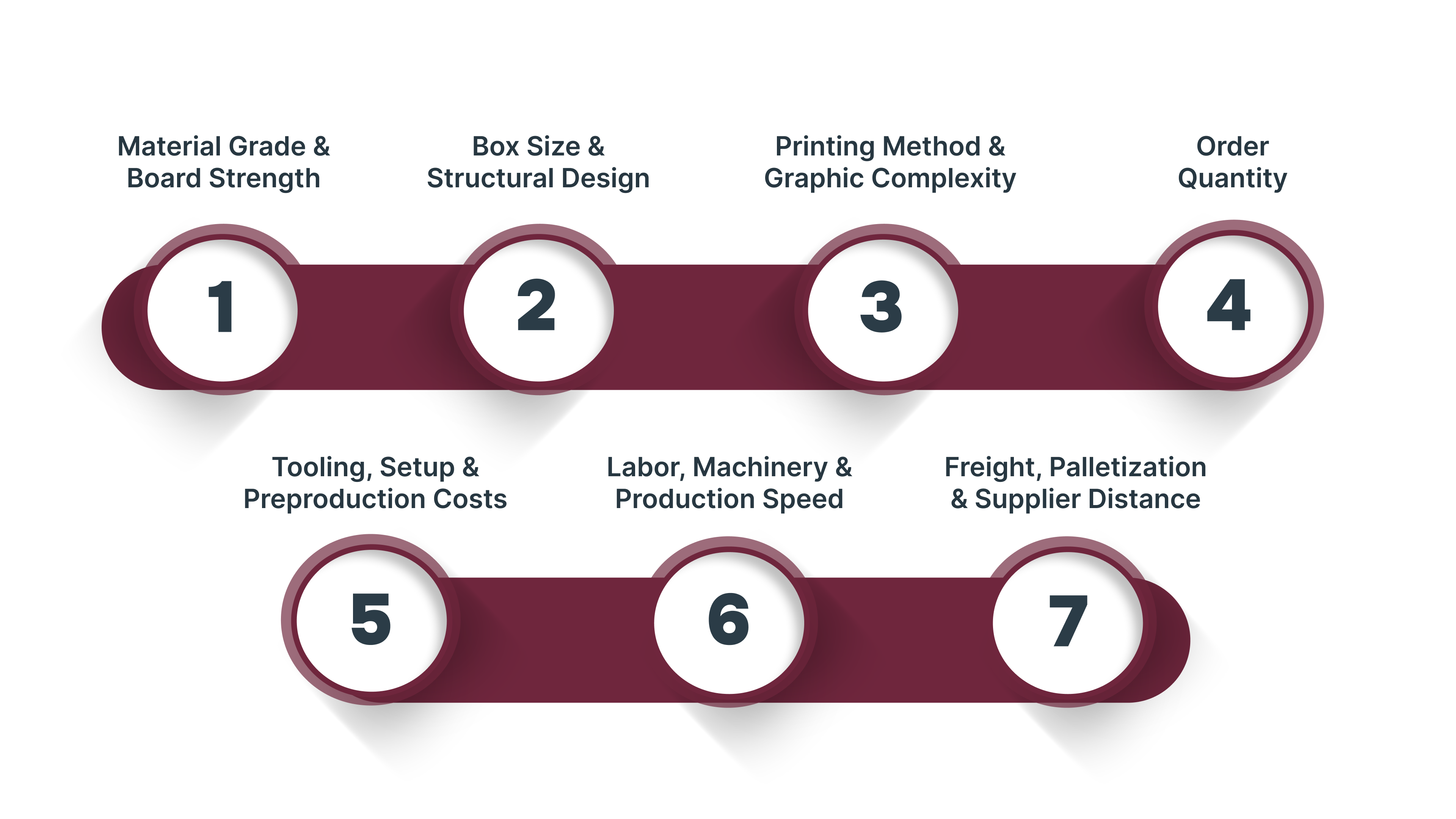
Once you know the type of box you need, the next step is understanding why prices vary. Even similar-looking boxes can differ in cost by 20–40% because several behind-the-scenes factors influence the final unit price.
Below are the core elements that impact how much a cardboard box costs to manufacture.
1. Material Grade & Board Strength (Biggest Cost Driver)
Material is the single largest component of box cost. The grade and thickness of your board determine both durability and price.
Key variables that influence cost:
Virgin vs recycled content
Flute type (E, B, C, or double-wall)
ECT or burst strength rating
White vs kraft surface
A stronger or whiter board looks great, but it also increases cost. Many brands unknowingly over-spec, paying more than needed for protection they don’t truly require.
2. Box Size & Structural Design
Larger boxes use more material and even a half-inch change in dimension can significantly change the cost.
What increases cost:
Oversized dimensions
Multi-piece constructions
Inserts or internal fitments
Unique shapes or custom dielines
A properly engineered structure can often reduce material usage without sacrificing protection.
3. Printing Method & Graphic Complexity
Your printing choices directly affect both setup fees and cost per unit.
Common printing methods:
Digital printing: No plates, best for small runs, higher unit cost
Flexographic printing: Affordable at scale, plate cost per color
Offset printing: Highest print quality, higher setup costs
Premium finishes, foil, soft-touch, embossing, spot UV, add cost but elevate brand perception.
4. Order Quantity (Economies of Scale)
The more boxes you order, the cheaper each one gets. Setup costs are spread across the entire run, dramatically lowering per-unit pricing.
Typical impact:
100 units → $3–$5 each
1,000 units → $1.50–$2.50 each
10,000 units → $0.75–$1.50 each
Small orders cost more not because of the box — but because of the setup behind it.
5. Tooling, Setup & Preproduction Costs
Depending on how your box is made, you may need:
Cutting dies (usually $300–$500)
Flexo printing plates ($100–$300 per color)
Structural prototypes
These are one-time costs but affect price per unit, especially for small runs.
6. Labor, Machinery & Production Speed
Not all box plants are equally automated.
Facilities with newer machines can run faster, use material more efficiently, and often offer lower pricing. More manual operations cost more.
7. Freight, Palletization & Supplier Distance
Corrugated boxes are light, but extremely bulky, which makes shipping a major cost factor.
Freight cost depends on:
Distance from manufacturer
Fuel surcharges
Pallet count
Box size (dimensional weight matters)
In many cases, shipping can add 10–25% to your total packaging cost.
This is one reason working with a local or regional supplier like GMS often reduces your overall spend.
Cost Examples & Simple Pricing Formulas
Understanding general ranges is helpful, but understanding what a box actually costs once materials, printing, labor, and freight are added together helps. Here are clear, real-world examples that show how pricing is calculated.
How Box Pricing Is Typically Calculated
A cardboard box’s price usually comes from five components:
Material
Printing
Labor / Machine Time
Tooling (amortized across quantity)
Freight & Palletization
= Final Cost Per Box
Small changes in any of these can shift your unit cost dramatically.
Example 1: Standard Corrugated Mailer (1,000 Units)
Cost Component | Estimated Cost |
|---|---|
Material (kraft, single wall) | $0.85–$1.00 |
Printing (1-color flexo) | $0.30–$0.40 |
Labor/Conversion | $0.20–$0.30 |
Tooling (spread across 1,000) | ~$0.05 |
Freight | $0.15–$0.25 |
Estimated Total: $1.60–$2.00 per box
Example 2: Small Run (100 Units)
Same box — but ordered as a short run using digital print:
Material: ~$0.90
Digital print premium: ~$1.00–$1.50
Labor: ~$0.30
Freight: ~$0.25
Estimated Total: $2.50–$3.00 per box
Why so much more?
Setup costs don’t shrink — only the quantity does.
Example 3: Premium Rigid Box (Gift / Luxury Packaging)
Chipboard + wrap materials: $2.00–$3.00
Hand-wrapping or semi-automated labor: $1.50–$3.00
Printing & finishes (foil, emboss, soft-touch): $0.50–$1.50
Inserts or magnets: $0.30–$1.00
Estimated Total: $4.00–$9.00+ per box
Rigid boxes are expensive because of labor and specialty materials, not board alone.
Example 4: Folding Carton (Retail Box)
SBS paperboard: $0.10–$0.25
Offset printing (full color): $0.15–$0.40
Cutting/creasing: $0.05–$0.10
Coating/finishes: $0.05–$0.15
Estimated Total: $0.35–$0.90 per box
This is why folding cartons remain a cost-effective option for retail shelves.
How to Reduce Your Cardboard Box Costs (Without Sacrificing Quality)
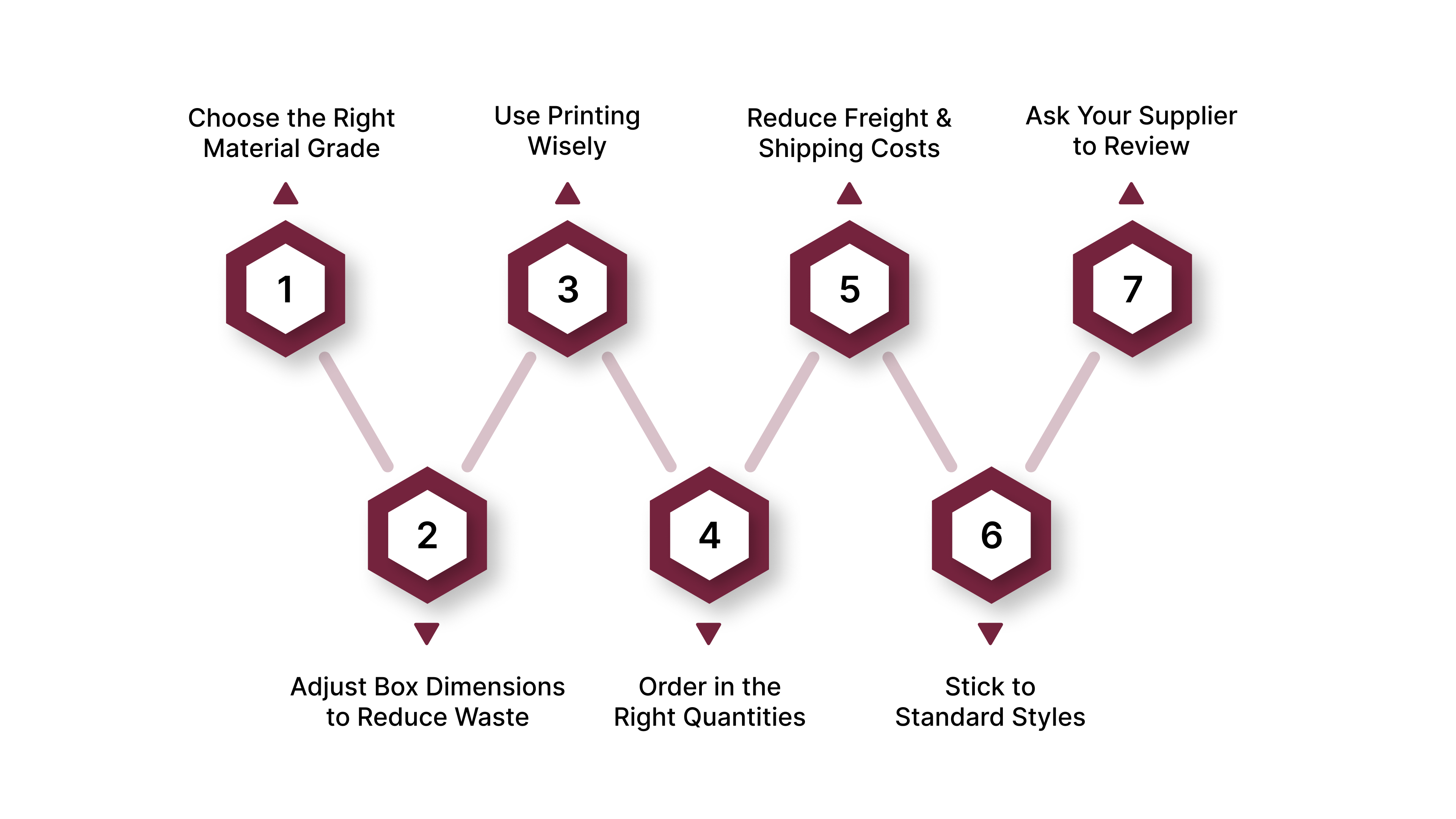
Most companies end up paying more for boxes than they should, usually because materials are heavier than necessary, order quantities aren’t optimized, or designs aren’t matched to the manufacturing method. Here are the most realistic ways to reduce cost while keeping your packaging functional and on-brand.
1. Choose the Right Material Grade (Not the Heaviest One)
Material strength is the biggest cost driver, and many brands default to board grades that are stronger and more expensive than their products require.
Ways to cut costs:
Use recycled kraft instead of virgin when possible
Choose the lightest flute type that still protects the product
Avoid double-wall unless absolutely necessary
A knowledgeable packaging supplier can help guide you toward the most cost-efficient grade during quoting.
2. Adjust Box Dimensions to Reduce Waste
Even a small size change can lower how much board your box uses.
Quick wins:
Reduce empty space inside the box
Use inserts or padding that allow for smaller outer boxes
Standardize dimensions across multiple SKUs
Small structural tweaks can lead to meaningful cost savings.
3. Use Printing Wisely
Printing is a major cost lever, especially with custom branding.
To lower printing cost:
Reduce the number of print colors
Avoid premium finishes unless they directly support brand value
Use digital print only for small runs
Use flexo or more economical print methods for mid-to-large volumes
This is where packaging partners, including GMS Industries, can offer guidance based on your artwork and order size.
4. Order in the Right Quantities
The biggest savings often come from increasing order volumes. Setup costs don’t change, so spreading them across more boxes lowers the per-unit price.
But ordering too much can lead to storage and cash flow issues.
Smart approach:
Order slightly larger quantities of your highest-volume SKUs
Adjust purchase cycles based on sales patterns
Combine multiple box types into a single production run when possible
Many customers find a middle ground that balances unit price with inventory limits.
5. Reduce Freight & Shipping Costs
Because boxes are bulky, freight can add 10–25% to total packaging cost.
To reduce freight spend:
Source from a supplier closer to your operations
Order quantities that maximize pallet efficiency
Avoid oversized boxes that trigger dimensional weight charges
GMS Industries’ U.S.-based manufacturing helps many companies keep freight more predictable, especially compared to long-distance or overseas sourcing.
6. Stick to Standard Styles When Custom Isn’t Necessary
Custom doesn’t always mean costly, but certain custom features do add avoidable expense.
Save cost by:
Using common styles (RSC, mailers, tuck-end, etc.)
Avoiding custom tooling unless the structure truly needs it
Simplifying any internal dividers or inserts
Your supplier can help determine when customization adds value, and when a standard structure works just as well.
7. Ask Your Supplier to Review Your Specs Periodically
Packaging becomes costly when specs haven’t been updated in years. Products change. Shipping methods change. Material pricing changes.
A periodic review often uncovers:
Overly heavy board grades
Outdated dimensions
Inefficient print setups
Opportunities for consolidation
Suppliers like GMS Industries, who take a collaborative approach, can help you refine your packaging as your business evolves.
Conclusion
Budgeting for cardboard boxes shouldn’t feel unpredictable, yet for many businesses it does. Prices fluctuate, quotes vary wildly, and it’s hard to know whether you're paying for true material requirements or simply carrying unnecessary cost.
But once you understand what actually drives box pricing, material grade, size, print method, order quantity, and freight, the numbers become far more manageable. Most brands discover they can reduce spend without sacrificing protection or presentation simply by choosing the right specifications and working with a supplier who helps them make informed decisions.
That’s where a partner like GMS Industries adds real value. As a family-owned packaging company since 1989, GMS focuses on clarity, collaboration, and custom solutions, helping businesses get reliable, well-made boxes, labels, and packaging components without waste or guesswork.
Ready to get a clear, accurate cost for your packaging? Contact GMS Industries to request a custom quote or discuss packaging options that fit your budget and your product.
FAQs
1. What is the average cost to manufacture a cardboard box?
Most cardboard boxes cost $0.35–$5.00+, depending on box type, size, material grade, printing, and order quantity. Corrugated shipping boxes typically fall in the $0.75–$3.50 range.
2. Why do different suppliers quote different prices for the same box?
Quotes vary because suppliers use different:
Board grades and flute types
Print methods
Labor rates and machine efficiency
Overhead and material sourcing costs
Freight and palletization methods
Even small differences in material grade or print setup can change the final cost.
3. What factors increase the cost of a cardboard box the most?
The biggest cost drivers are:
Board strength and material type
Box dimensions
Multi-color or specialty printing
Low order quantities
Long-distance freight
Improperly specified board grade is one of the most common sources of overspending.
4. Is custom packaging always more expensive?
Not always.
Custom boxes add cost when:
New tooling is required
Complex designs or inserts are used
Premium printing or finishes are added
However, custom sizing can actually reduce cost by eliminating wasted space and excess material.
5. How can I lower my box costs without reducing quality?
You can lower cost by:
Right-sizing your material grade
Slightly reducing box dimensions
Simplifying printing
Ordering more efficient quantities
Working with a supplier closer to your location
A collaborative packaging partner can help you identify where savings make sense and where performance shouldn’t be compromised.